Real-time seismic data from libmseed using a Raspberry Pi with 512MB of RAM and an ARM single-processor
The optimization of simple systems allows hardware like a basic Raspberry Pi with 512MB of RAM and an ARM single-processor to be used for multiple large and important tasks.
Reading time: 3 minutes
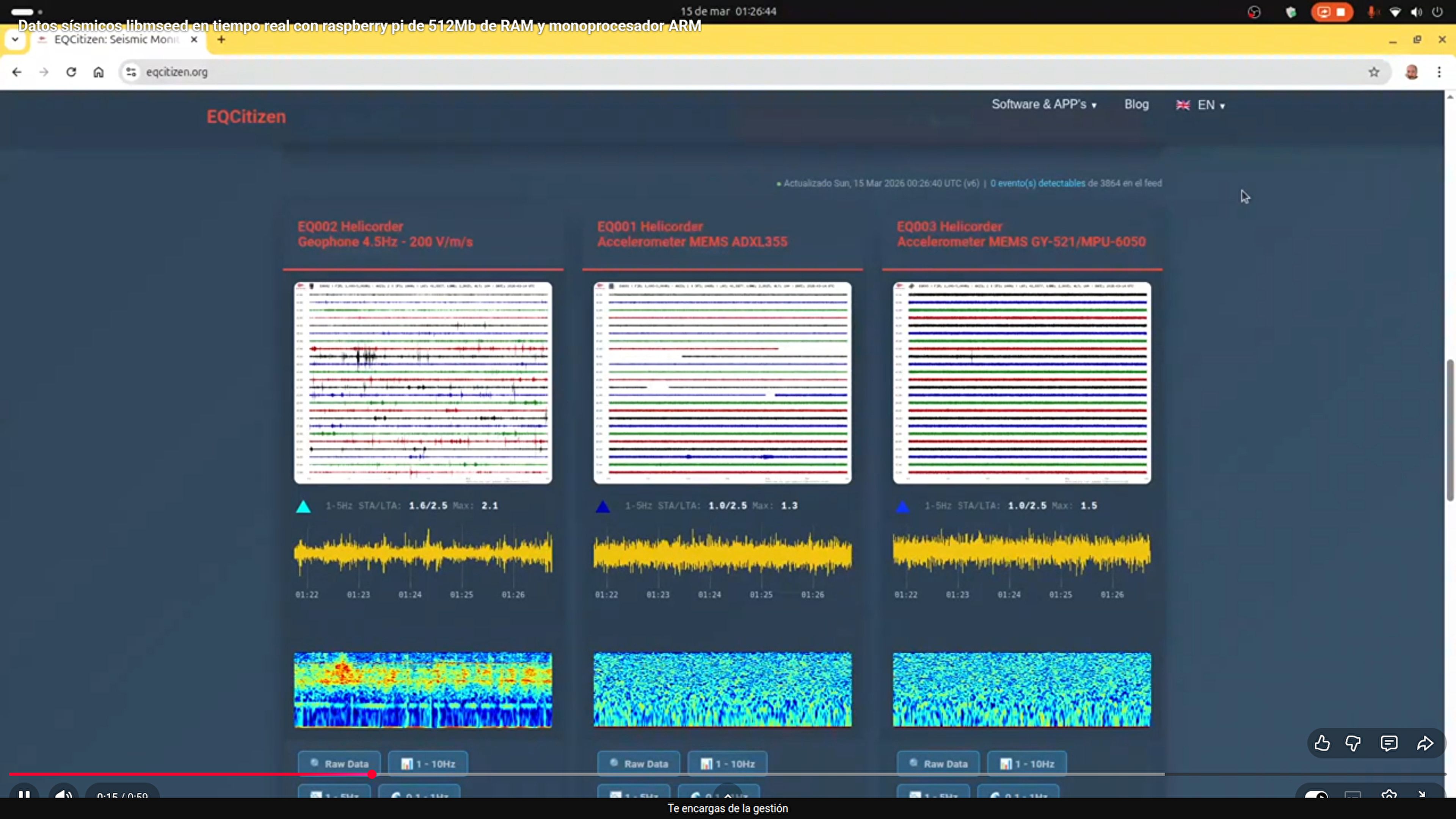
In the example screenshot, this Raspberry Pi executes multiple processes to capture seismic data:
It reads raw data from the three axes (X, Y, Z) in real time at 1000 Hz from an ADXL355 accelerometer sensor.
It applies a downsample at 100 Hz.
It applies a notch filter at 50 Hz to remove unnecessary data from the signal.
It applies gravity correction to the Z-axis.
It saves the resulting raw data in memory.
It generates .mseed files with the final raw data stored in memory. It applies periodic calibration to compensate for the deviation of each individual axis and keep the data centered on the 0 axis.
It applies 26 different IIR filters to each axis to obtain the split signal and detect different types of events, such as nearby earthquakes, shocks, distant earthquakes, etc.
It applies an STA/LTA filter to each axis, allowing it to identify the event within a specific Hz and axis range.
It detects the RMS energy of all three axes.
It detects the arrival time of the event using the Kurtosis method.
It detects the arrival of the seismic wave using a secondary AIC algorithm.
It triggers alerts using individual time windows for each filter if the Trigger Threshold, adapted to each Hz and axis range, is exceeded. It has an nginx web server to display the control panel.
It sends raw data from all of the above to the control panel via WebSockets.
It generates raw mseed files for all three axes on an SD every minute to keep the generated data safe on the memory card.
It applies an FIR filter to each of the Hz ranges to generate a more visually appealing helicorder graph.
It generates helicorders for five different ranges, allowing you to visualize any events and see how they have affected different ranges.
It sends the previous helicorders to the main server for external viewing on the internet.
It has a libseed server to connect directly and collect data with other software, such as Swarm.
This same server sends the libseed data to a central server, where it will be redistributed publicly and in real time. The dashboard incorporates a system that connects to various official agencies every 30 seconds to receive the latest events. If available, it includes a wave arrival system to visualize the timing and how each type of wave affects the signal at the precise moment, calculating the origin and arrival at the station using the AK135 method based on geodetic coordinates.
The control panel allows connection to mseed servers to compare the station's waveform with those of other professional stations.
It also includes the generation of a spectrogram to visualize the signal strength and its distribution over a time window. This allows for real-time viewing of the strength of an event distributed across the entire signal width.
One might think that such a limited Raspberry Pi couldn't generate so much data, in so many ways, and in such a short time, considering the limited available memory and the fact that we only have a single processor. Therefore, socket connections, data and file generation, the web server, etc., all occur on the same CPU without the possibility of separate multithreading. However, far from crashing, the system handles it perfectly. There are no data outages. The only outages have been due to intentional service restarts, source code recompilation, and/or changes and updates. The system is stable.
Since the data is now available externally, I've implemented another service on the main server that collects the libseed data in real time and redistributes it, allowing it to be decrypted and displayed in real time using JavaScript.
This is precisely what I've set up. A real-time system allows simultaneous monitoring of all three seismic stations, each equipped with different types of sensors. This is precisely what will help us interpret how the signal behaves and appears at each sensor (accelerometers and geophones).
This video demonstrates the perfect synchronization of the system's date and time with the graph data, which are only a few milliseconds behind, confirming what was previously mentioned.
This is a spectacular achievement with very limited and outdated hardware. The challenge is making it work with the bare minimum. Knowing that it works, making it work on current, fast hardware will be no problem.
Video:
Rafael Martín Soto - IT CEO / Artificial Intelligence
Other related blog posts:
By clicking 'Accept all cookies', you agree to cookies being stored on your device to enhance site navigation, analyze site usage, and assist in our marketing efforts.
When you visit any website, it may store or retrieve information on your browser, mostly in the form of cookies. This information might be about you, your preferences, or your device and is mostly used to make the site work as you expect it to. The information does not usually directly identify you, but it can give you a more personalized web experience. Because we respect your right to privacy, you can choose not to allow certain types of cookies. Click on the category headings to find out more and change our default settings. However, blocking some types of cookies may affect your experience of the site and the services we are able to offer.
These cookies are necessary for the website to function and cannot be disabled in our systems. They are usually set in response to actions you take to request services, such as setting your privacy preferences, logging in, or filling out forms. You can set your browser to block or alert you about these cookies, but some parts of the website will not work. These cookies do not store any personally identifiable information.
Performance Cookies
These cookies allow us to count visits and traffic sources so we can measure and improve the performance of our site. They help us understand which pages are the most and least popular and see how many people visit the site. All information these cookies collect is aggregated and therefore anonymous. If you do not allow these cookies, we will not know when you visited our site.
Functionality Cookies
These cookies enable the site to provide enhanced functionality and personalization. They may be set by us or by third parties whose services we have added to our pages. If you do not allow these cookies, some of our services will not function properly. They also enable security-related storage, such as authentication functionality, fraud prevention, and other user protection.
Targeted cookies
These cookies may be set throughout the website by our advertising partners. These companies may use them to build a profile of your interests and show you relevant ads on other sites. They do not store personal information directly, but are based on uniquely identifying your browser and internet device. If you do not allow these cookies, you will experience less targeted advertising.
Social media cookies
These cookies are set by a number of social media services that we have added to the site to enable you to share our content with your friends and networks. They are capable of tracking your browser across other sites and building a profile of your interests. This may affect the content and messages you see on other websites you visit. If you do not allow these cookies, you will not be able to see or use these sharing tools.


 View full profile of Rafael Martín Soto
