Do the vibrations from a washing machine or dryer affect a seismic station?
It might seem like a silly question, but we won't know until we test it. Is it possible that vibrations could affect the data collected by a Citizen seismic station, causing us to detect tiny vibrations? Let us explain.

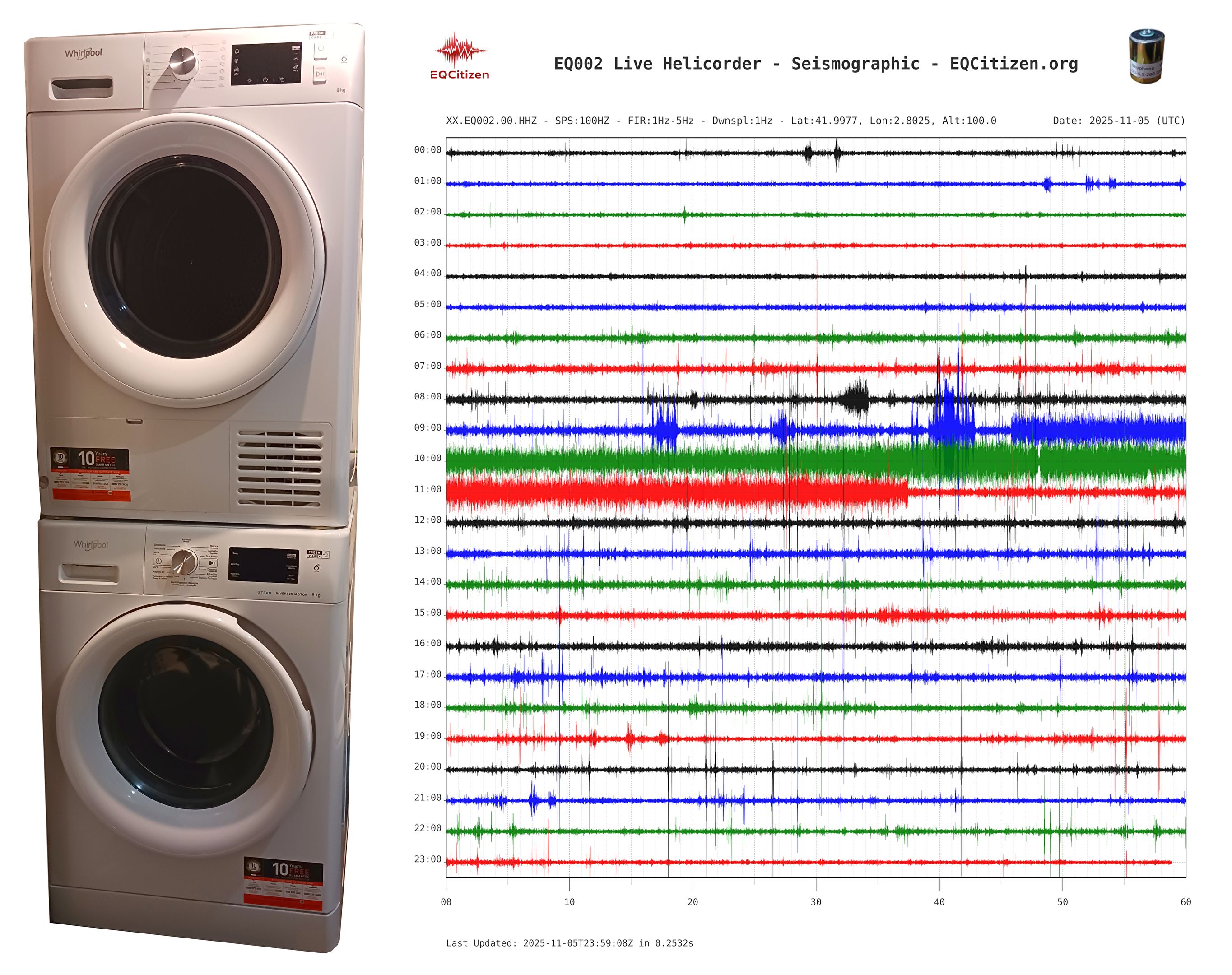
The geophones at seismic stations are typically very sensitive, even to micromovements, so it's expected that any nearby vibration will be picked up by these stations. What might seem like household noise can be transformed into useful data. We have to consider that if it's possible to capture these vibrations, we'll also capture others that have gone unnoticed until now, such as a garbage truck, children playing in the street, or a noisy motorcycle. Now we have the opportunity to analyze our surroundings and turn them into useful data.
Seismic stations don't always coexist harmoniously with the home, but this is an expected issue; they are, after all, Citizen devices. The stations used for this test were installed 3.5 meters away from the washing machine and dryer, under the exact conditions shown in the image (the dryer on top of the washing machine). For this test, we used the three stations we have under review:
- 4.5Hz - 200 V/m/s geophone
- Mid-range ADXL355 MEMS accelerometer
- End-range GY-521/MPU-6050 MEMS accelerometer and gyroscope
The graph accompanying this article illustrates this clearly. On November 5, 2025, at approximately 9:45 UTC, the washing machine was turned on. These appliances usually operate at low frequencies. The frequencies shown in the capture are between 1 and 5 Hz.
It's clear that the movement gradually accelerates, reaching its maximum speed during the spin cycle, until finally, around 10:50 UTC, there is a brief pause. At that moment, the washing machine stopped, and the clothes were removed and transferred to the dryer, which is installed above the washing machine, just like the one in the image.
In a very short time, just a few seconds, the dryer started. It's important to note that, being on top of the washing machine, there is already some dampening of the movement, so the waves are slightly attenuated, but this doesn't prevent the station from detecting them. The dryer's vibration is quite similar to the washing machine's, although slightly less pronounced. As you can see, the process lasted approximately 50 minutes.
In short, a seismic station clearly detects the movements of household appliances. The signal was compared with a MEMS ADXL355 accelerometer and a GY521-MPU6050. The first one didn't detect anything, and the second, as expected, detected even less.
These graphs are available in both original and SVG formats, allowing you to visually compare the data from the three sensors on the website. Simply go to the homepage of https://eqcitizen.org and select November 5, 2025. You can then see how the graphs appear at different frequency frequencies and compare them for each sensor.
Rafael Martín Soto - IT CEO / Artificial Intelligence

Rafael Martín Soto
Computer scientist by vocation. Organization of conventions, presentations, advanced studies in Artificial Intelligence and optimization of resources. More than 20 years of experience in server administration, web and cybersecurity. Lover of the use and optimization of natural resources, recycling and nature
Technical specialist in management informatics View full profile of Rafael Martín Soto