Seismography 2.0: Converting wind vibrations into climate data
From data chaos to visual clarity. Discover how we process seismic signals to monitor the impact of wind in real time, separating urban "bumps" from the continuous energy of the air.

Here is the English version of your blog post, optimized for a professional yet accessible "Citizen Science" audience.
Seismography 2.0: Converting Vibrations into Climate Data
From Data Chaos to Visual Clarity
Can the ground beneath our feet tell us how hard the wind is blowing? The short answer is yes, but extracting that information is no simple task. In seismic stations located near urban areas, wind isn't the only thing making the sensor vibrate; traffic, industry, and human activity create a constant "noise" that often masks the signals of nature.
In this article, we break down how we managed to separate the "hits" of the city from the continuous energy of the air in the Gironès region.
The Challenge: Spikes or Density?
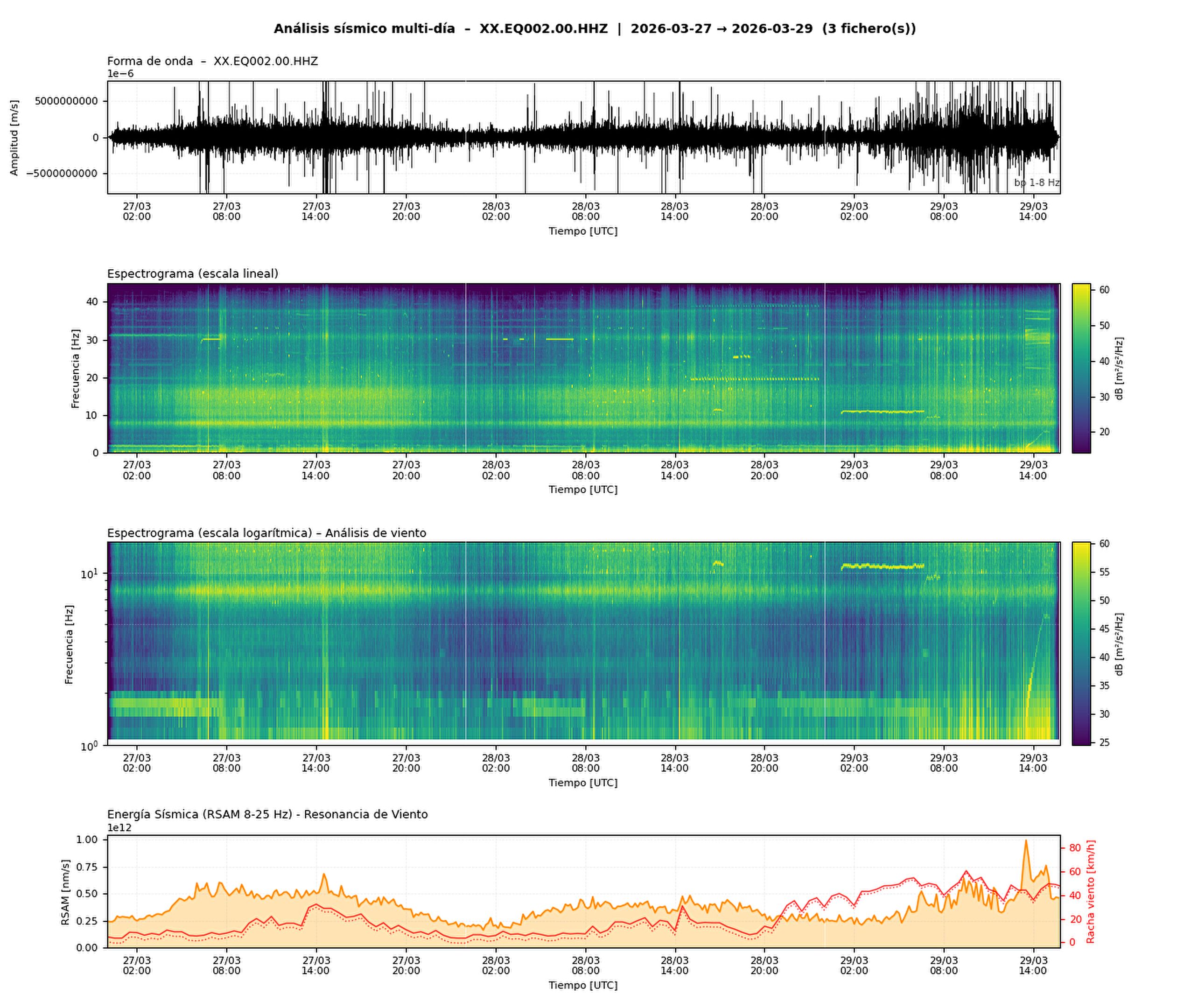
When we look at a raw seismogram, we see a tangle of traces. During workdays, the graph is filled with transient spikes: passing cars, machinery, or urban activity. These spikes have high amplitude but last only a very short time.
Wind, however, behaves differently. It isn't a sharp hit; it is a continuous energy that causes the seismic trace to become "thicker" or denser. The mathematical challenge was: How do we ignore the high spikes from cars to measure only the thickness of that black wind smudge?
The Techniques Used
To solve this, we applied a three-step processing workflow:
-
Band-pass Filtering (1.0 - 8.0 Hz): We centered the analysis on low frequencies. Although wind (and rain) energy can reach up to 45 Hz, it is in this 1–8 Hz range where the wind's push against trees, buildings, and the ground itself generates a resonance signal. This allows a citizen sensor to capture the data with higher fidelity, moving away from electrical noise and high-frequency urban vibrations.
-
Median-based RSAM: Unlike a conventional average (which is easily skewed by car spikes), we use the median amplitude in 10-minute windows. The median finds the "typical" value of the period; if a truck passes by for 5 seconds, the median ignores it, staying focused on the constant blow of the wind that occupies the rest of the time.
-
Multi-station Correlation: To validate our model, we overprinted wind speed data from an automatic weather station onto our seismic energy curve (RSAM).
Case Study: Girona [XJ]
The analysis focused on the seismic station [XJ], located in the Gironès region. This location is strategic but presents a logistical challenge: the distance to the reference weather station.
| Data Point | Detail |
| Seismic Station | Girona [XJ] |
| Coordinates | 41.98215º N, 2.80552º E |
| Distance between stations | 1.75 km |
| Frequency Band | 1.0 - 8.0 Hz |
| Energy Metric | RSAM (Median-based) |
Technical note on distance: It is essential to account for the 1.75 km gap between the seismograph and the automatic weather station. Wind is not uniform; gusts can vary significantly over just a few kilometers due to the orography of the Gironès area. However, the visual correlation we obtained between the "density" of the seismic trace and the recorded wind speeds confirms that the ground is acting as a giant anemometer.
Conclusions
This experiment proves that citizen seismographs are not just for detecting earthquakes. By applying intelligent filtering and robust statistics (the median), we can turn environmental noise into valuable climate data. We have moved from seeing a "dirty" trace on the final day to understanding that this density was, in fact, the sonic signature of a wind storm.
Seismography 2.0 doesn't just listen to the Earth; it listens to the sky.
Rafael Martín Soto - IT CEO / Artificial Intelligence

Rafael Martín Soto
Computer scientist by vocation. Organization of conventions, presentations, advanced studies in Artificial Intelligence and optimization of resources. More than 20 years of experience in server administration, web and cybersecurity. Lover of the use and optimization of natural resources, recycling and nature
Technical specialist in management informatics View full profile of Rafael Martín Soto