Can thunder be detected with a Citizen seismic station?
In this article, we'll explain whether it's possible to detect thunder with a Citizen seismic station and examine the differences in the waves captured between a geophone calibrated to 4.5Hz, a mid-range ADXL355 MEMS accelerometer, and a low-cost GY-521/MPU-6050 MEMS gyroscope accelerometer.

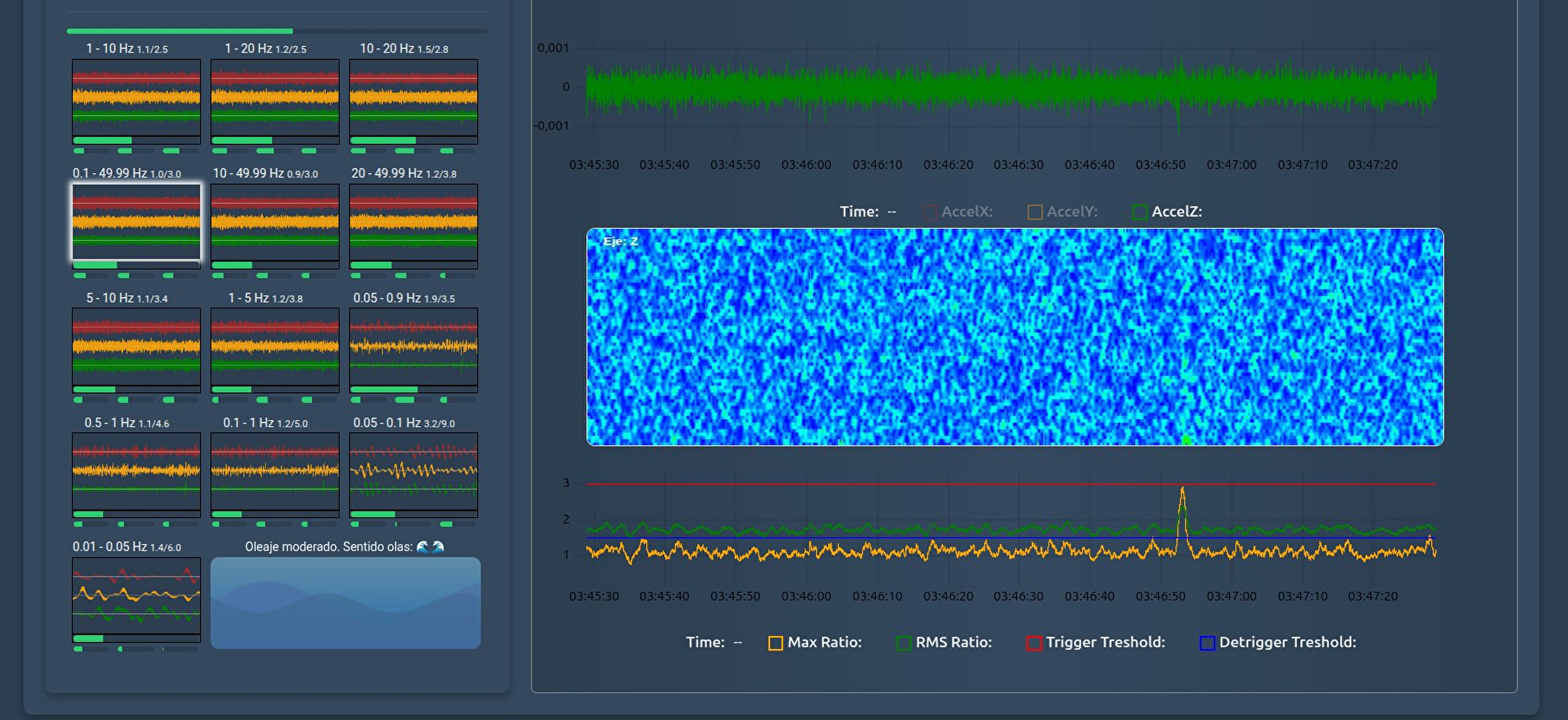
The image accompanying this article is a capture from one of our seismic stations. Specifically, it's station 001, which uses a mid-range ADXL355 MEMS accelerometer as its sensor.
In the green graph in the middle of the screen, you can see a peak. This corresponds to thunder. In this case, you can also see the low-Hz mark it left on the spectrogram. The yellow line just below shows the alarm level for a rapid event, as in this case, which triggered the alarms immediately.
In the graphs on the left, you can also see the mark left by this thunder in the green lines and low-Hz range.
So, we answer, yes, it's possible to detect thunder with a Citizen seismic station, but... if an ADXL355 could detect it, what would a geophone detect? And could a low-end accelerometer also detect it?
To see how far this is possible, we'll choose another day, an episode with a high electrical charge, causing numerous thunderstorms, which will allow us to compare the three sensors.
Next, we'll look at comparative helicorders from three stations, each with three different types of sensors.
| Geophone 4.5Hz - 200 V/m/s | Mid-range MEMS ADXL355 accelerometer | Low-end MEMS accelerometer GY-521/MPU-6050 |
These graphs show that the event occurred between 8:00 and 9:30 UTC, during which the geophone clearly captured both thunder and torrential rain. The ADXL355 accelerometer did manage to detect some thunderclaps, but they were far less sensitive than the geophone. The GY-521/MPU6050 accelerometer was lucky enough to detect one. It failed to capture any of the others, no matter how loud they were.
Conclusion
A mid-range geophone and accelerometer can both detect thunder, with the geophone being more likely to do so than the accelerometer. A low-cost accelerometer will hardly be able to detect it at all. This is due to the significant background noise it incorporates, and this is the key difference between a low-cost model and a mid-range one, which even then struggles to capture these movements.
Rafael Martín Soto - IT CEO / Artificial Intelligence

Rafael Martín Soto
Computer scientist by vocation. Organization of conventions, presentations, advanced studies in Artificial Intelligence and optimization of resources. More than 20 years of experience in server administration, web and cybersecurity. Lover of the use and optimization of natural resources, recycling and nature
Technical specialist in management informatics View full profile of Rafael Martín Soto
Other related blog posts:
Can rain be detected with a Citizen seismic station?

Can fireworks be detected with a Citizen seismic station?
