Can fireworks be detected with a Citizen seismic station?
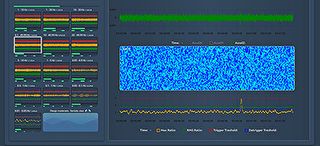
We will investigate this using video footage from an ADXL355 accelerometer sensor and seismogram analysis from a geophone calibrated to 4.5 Hz. Watching the video to see how the alarms respond to these events will help you understand how they work.
Reading time: 2 minutes
An explosion has a very different effect on sensors than an earthquake, but it is still a movement of air that can be transmitted through the ground. There is a method for calculating the movement created by a fault using what is called a 'beach ball,' which indicates the type of fault, the direction of its movement, and how it has moved. This is achieved by calculating the movement of seismic stations. When the P-wave reaches a station, the station can move up, down, left, or right, and this movement varies from the epicenter outwards. All these movements allow us to determine the origin and what has happened to that fault.
What happens with an explosion? The wave that reaches the stations is exactly the same, so the movement of all of them is identical. This would produce a single color on the 'beach ball,' making it completely one color without indicating any special movement. Therefore, an explosion is not useful for indicating how it occurred, as this type of movement is not present in explosions. The only thing that could be determined is the epicenter of the explosion.
What is certain is that the movement is felt and can be measured. Citizen seismic stations can detect it perfectly.
The video accompanying this article shows the night of June 23, 2025, which is the night of San Juan (St. John's Eve). In Catalonia and the Valencian Community, the night is celebrated by launching rockets and firecrackers, making it a good day to investigate this event with our Citizen seismic stations.
What's special about this video is that it shows the different Hz ranges into which the seismic signal is divided, making it very clear which Hz are most affected by explosions. An explosion is sudden, powerful, and immediate, so the ranges that usually trigger alarms are those of high frequencies, especially if the firecracker exploded very close to the seismic station. You can see in the video how the alarms closest to the highest Hz ranges all go off at once. This is a very visual way to understand how seismic waves, or in this case, explosive waves, work.
These waves were captured with a mid-range ADXL355 MEMS accelerometer.
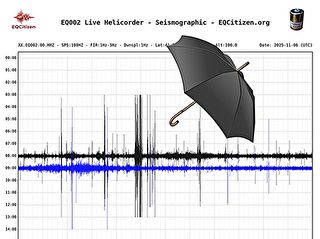
The following graph shows the waves captured by a geophone on November 2, 2025. These are from the fireworks display that closed the Sant Narcís festivities in the city of Girona. The seismic station is located 1.2 km away from where the fireworks were launched, and, as you can see, they were perfectly captured by the station. They lasted approximately 15 minutes (in fact, the image on the blog's homepage is from one of these explosions).
Video:
Rafael Martín Soto - IT CEO / Artificial Intelligence
Other related blog posts:
Can rain be detected with a Citizen seismic station?
Can thunder be detected with a Citizen seismic station?
By clicking 'Accept all cookies', you agree to cookies being stored on your device to enhance site navigation, analyze site usage, and assist in our marketing efforts.
When you visit any website, it may store or retrieve information on your browser, mostly in the form of cookies. This information might be about you, your preferences, or your device and is mostly used to make the site work as you expect it to. The information does not usually directly identify you, but it can give you a more personalized web experience. Because we respect your right to privacy, you can choose not to allow certain types of cookies. Click on the category headings to find out more and change our default settings. However, blocking some types of cookies may affect your experience of the site and the services we are able to offer.
These cookies are necessary for the website to function and cannot be disabled in our systems. They are usually set in response to actions you take to request services, such as setting your privacy preferences, logging in, or filling out forms. You can set your browser to block or alert you about these cookies, but some parts of the website will not work. These cookies do not store any personally identifiable information.
Performance Cookies
These cookies allow us to count visits and traffic sources so we can measure and improve the performance of our site. They help us understand which pages are the most and least popular and see how many people visit the site. All information these cookies collect is aggregated and therefore anonymous. If you do not allow these cookies, we will not know when you visited our site.
Functionality Cookies
These cookies enable the site to provide enhanced functionality and personalization. They may be set by us or by third parties whose services we have added to our pages. If you do not allow these cookies, some of our services will not function properly. They also enable security-related storage, such as authentication functionality, fraud prevention, and other user protection.
Targeted cookies
These cookies may be set throughout the website by our advertising partners. These companies may use them to build a profile of your interests and show you relevant ads on other sites. They do not store personal information directly, but are based on uniquely identifying your browser and internet device. If you do not allow these cookies, you will experience less targeted advertising.
Social media cookies
These cookies are set by a number of social media services that we have added to the site to enable you to share our content with your friends and networks. They are capable of tracking your browser across other sites and building a profile of your interests. This may affect the content and messages you see on other websites you visit. If you do not allow these cookies, you will not be able to see or use these sharing tools.




 View full profile of Rafael Martín Soto